The Feedback-Action Gap: Why Employees Stop Speaking Up
When employees can see that feedback shapes conversations, decisions and priorities (even in small ways) trust grows surprisingly quickly.
Read MoreIf you’ve ever looked at a set of survey results and thought, “I know there’s more to this story,” you’re probably right.
When you’re looking at employee feedback, it’s easy to get lost in the averages.
A 70% satisfaction score can look great on paper… until you dig a little deeper and realise that while one team is thriving, another is quietly burning out.
That’s the blind spot in employee feedback summed up – and exactly why segmentation in employee engagement analysis matters so much.
Simply put, segmentation turns feedback into something you can actually act on.
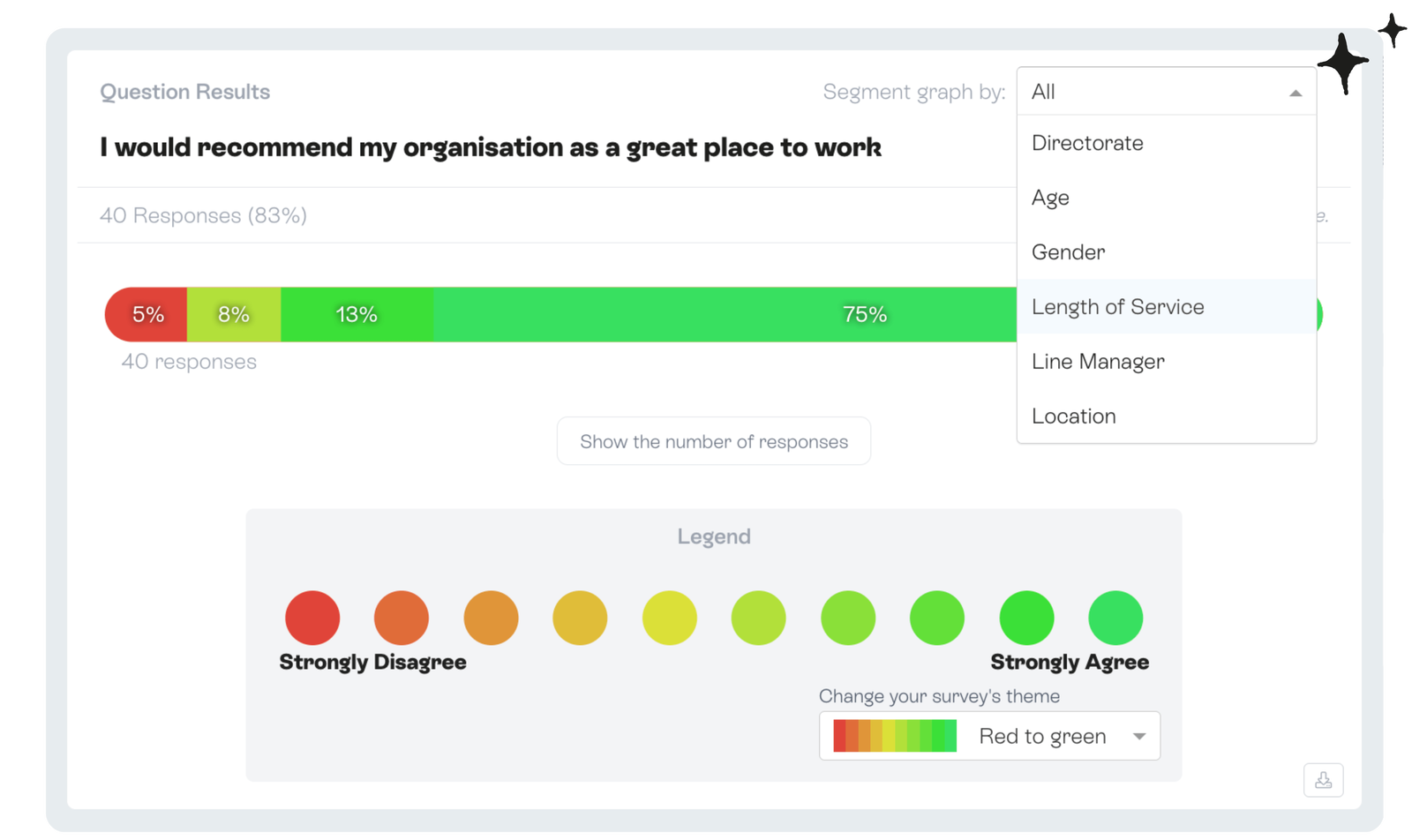
Segmentation lets you break your survey data down into meaningful groups – like department, location, job level, or length of service, so you can spot trends, challenges, and successes across different areas of your organisation.
It helps you answer questions like:
By viewing feedback through different lenses, you can see which parts of your organisations are succeeding and where people need more support.
That’s the real value of segmentation – it gives you the clarity to focus your efforts where they’ll have the biggest impact.
Many companies still rely on top-line results from surveys.
It’s quicker, it looks clean, and it feels like progress.
But the problem is, aggregated data tells you what is happening – but not where or why.
Here’s what that can look like in real work-life scenarios:
Without segmentation, you’re essentially taking one big average and calling it insight, when in reality, it’s not the whole picture.
Too often, teams celebrate good headline results without realising they’re missing the story underneath. Segmentation helps you understand where and who needs support.
At Stribe, we built our employee survey platform to help teams go beyond the averages.
Our segmentation features make it easy to explore your data from every angle, without the faff of spreadsheets or compromising anonymity.
Here’s how it works:

When you understand the who behind your feedback, your next steps become a lot clearer.
That’s how meaningful change happens, by listening to the right voices, in the right context, and acting on what you learn.
With Stribe, you can uncover what’s really going on across every corner of your organisation. Our segmentation tools make your feedback more focused, your insights more accurate, and your actions more effective.
About the author

Starting out her early career as a journalist, Jade Madeley is an accomplished content writer with 8+ years’ experience across business, personal finance, SaaS, human resources and employee engagement. Working with Stribe, she crafts insightful content that brings complex HR topics to life and drives meaningful action.
When employees can see that feedback shapes conversations, decisions and priorities (even in small ways) trust grows surprisingly quickly.
Read MoreConfidence in how well organisations measure engagement is surprisingly low. Only 14% feel very confident they measure engagement effectively.
Read MoreWe asked HR professionals where they believe the most attention is needed over the next 12 months. The results reveal something interesting.
Read More